
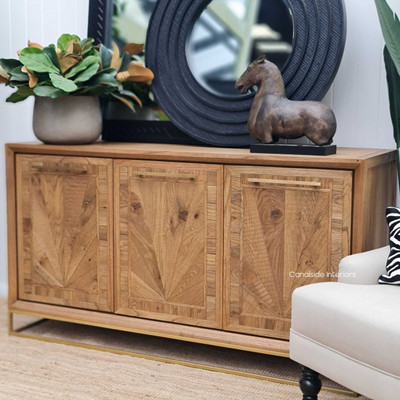
What Is the Difference Between a Console Table and a Side Table?
Canalside Interiors on 26th Aug 2026
So what is the difference between a console table and a side table? In short, it comes down to size, height and placement, but understanding exactly how, and why it matters, will save you from buying a piece that looks right in a photo but never quite works in your home.
The good news is that once you understand what separates these pieces, picking the right one for your requirements becomes much easier. This guide breaks down exactly what a console table is, what a side table is, and how to tell them apart, so you can shop with genuine confidence.
1. What Is a Console Table?
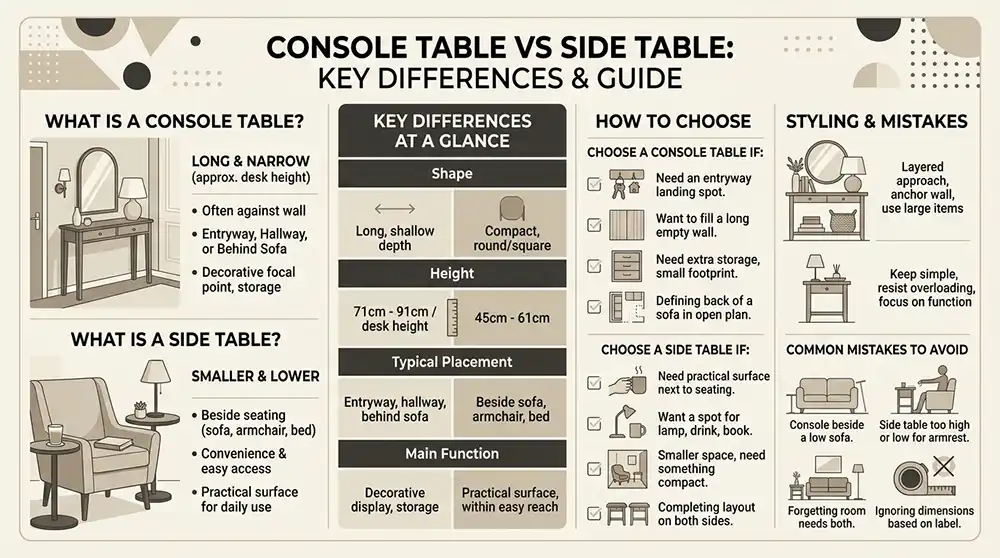
A console table is a long, narrow, fairly shallow table, generally sitting at around desk height. It is most commonly placed against a wall, whether that is in an entryway, a hallway, or behind a sofa in an open plan living space. When a console table is placed directly behind a sofa, it is sometimes called a sofa table, though the two terms are largely used interchangeably.
2. What Is a Side Table?
A side table, sometimes called an end table, is a smaller, lower table designed to sit beside a piece of seating, most commonly a sofa, an armchair, or a bed. Its whole purpose is convenience, giving whoever is seated a nearby surface for a lamp, a drink, a book, or a phone.
3. Key Differences at a Glance
| Feature | Console Table | Side Table |
| Shape | Long and narrow, shallow depth | Compact, can be round, square or rectangular |
| Height | 71cm to 91cm, desk height | 45cm to 61cm, lower than a console |
| Typical Placement | Against a wall, entryway, hallway, or behind a sofa | Beside a sofa, armchair or bed |
| Main Function | Decorative focal point, display, storage | Practical surface within easy reach when seated |
4. How to Choose the Right One for Your Space
The easiest way to decide between the two is to start with the actual problem you are trying to solve, rather than the piece of furniture itself. Ask what the empty space is currently doing, or failing to do, and the right answer usually becomes obvious fairly quickly.
Choose a console table if:
- You have an entryway or hallway that needs a decorative, functional landing spot
- You want to fill a long, empty stretch of wall with visual interest
- You need extra storage without taking up much floor space
- You are working with an open plan layout and want to define the back of a sofa
Choose a side table if:
- You need a practical surface next to a sofa, armchair or bed for everyday use
- You want a spot for a lamp, drink, book or phone within easy reach
- You have a smaller space and need something compact and easy to move
- You are furnishing a seating area and want to complete the layout on both sides
Many rooms genuinely benefit from both. A console table behind the sofa or in the entryway, paired with a side table at the end of the sofa itself, covers both the decorative and practical sides of the room without either piece competing for the same job. Thinking of them as complementary rather than interchangeable is really the key to getting the most out of both pieces.
5. Styling Each Type of Table
Console tables suit a layered approach, working from the bottom up. Start with a larger item, such as a woven basket or a vessel, then anchor the wall above with a mirror or artwork. A lamp adds warmth, and a stack of books or a small vessel finishes the look without overcrowding the surface. For a full breakdown of this approach, our guide on console table decor ideas covers styling formulas in more depth.
Side tables work best kept simple. A tray to corral small items like coasters or a remote, a table lamp, and one personal touch, whether that is a plant, a candle, or a stack of your current reads, is usually enough. Since a side table is there to be used daily, resist the urge to overload the surface with decor that gets in the way.
If you have a side table on each end of a sofa, they do not need to be perfectly matched to feel intentional. Keeping them at a similar height and roughly the same visual weight is generally enough, even if the finishes or shapes differ slightly. This small bit of asymmetry can actually make a room feel more considered and personal than a rigid matching pair.
6. Common Mistakes to Avoid
- Using a console table where a side table is needed. A tall, narrow console beside a low sofa arm will feel awkward and impractical for everyday use.
- Choosing a side table that is the wrong height. A side table that sits much higher or lower than your sofa arm makes reaching for items uncomfortable.
- Overlooking clearance. A console table that is too deep for a narrow hallway becomes an obstacle rather than a feature.
- Forgetting the room needs both. A living room with a console but no side table, or the reverse, often ends up either impractical or visually unfinished.
- Buying based on the name alone. Since console, side, end and sofa table are used loosely across different retailers, always check the actual dimensions and intended placement rather than assuming a listing labelled one way will automatically suit your space.
|
Browse our range of console tables and side tables to find the right piece for your space. |
Frequently Asked Questions About Console and Side Tables
Q: What is the main difference between a console table and a side table? |
| A: A console table is long, narrow and desk height, usually placed against a wall or behind a sofa as a decorative focal point. A side table is smaller and lower, placed beside seating to hold items within easy reach. |
Q: How tall should a console table be? |
| A: Most console tables sit between 71cm and 91cm high, roughly desk height. If placed behind a sofa, aim for a height close to or slightly below the sofa back so it does not visually stick out. |
Q: Can I use a side table instead of a console table? |
| A: Not usually as a direct swap. A side table is designed for close, everyday use beside seating, while a console table is built to stand alone against a wall or fill a larger space. Using one in place of the other often looks and functions awkwardly. |
Q: Do I need both a console table and a side table? |
| A: Many living rooms benefit from both, a console table for entryway or behind-sofa styling, and a side table for practical use beside seating. Whether you need both depends on your layout and how the room is used day to day. |