
Bedside Table Height Guide: What Size Do You Need?
Canalside Interiors on 25th Aug 2026
A bedside table seems like a simple piece of furniture, until you bring one home and realise it sits five centimetres too low, or juts out so far that you stub your toe every time you get out of bed. Getting the size right is not just about aesthetics, it genuinely changes how comfortable and functional your bedroom feels.
This guide focuses specifically on bedside table height, width and depth, the factors you actually need to confirm before you buy.
1. Why Bedside Table Height Matters
Size is not just a number on a spec sheet; it is the difference between a comfortable nighttime routine and constant small frustrations. A bedside table that is too tall means reaching upward awkwardly in the dark. One that is too low means bending down or knocking items over.
Getting the proportions right also matters visually. A tiny table beside a king bed can look lost, while an oversized table beside a single bed can overwhelm the room. Matching your bedside table's size to your bed will help create a bedroom that feels balanced and considered rather than mismatched.
2. Standard Bedside Table Dimensions
Most bedside tables fall within a fairly consistent range, regardless of style or brand.
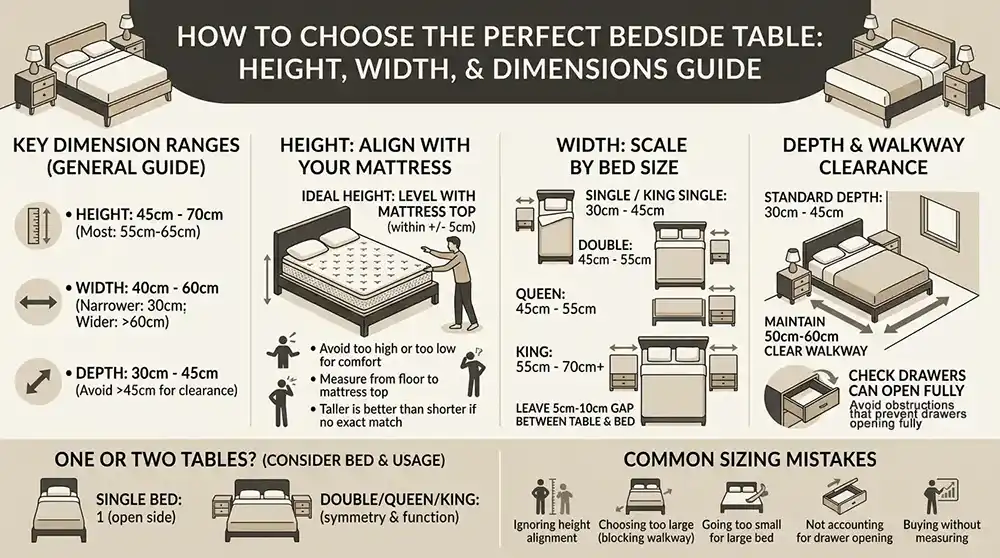
- Height: 45cm to 70cm, with most falling between 55cm and 65cm
- Width: 40cm to 60cm, with narrower options around 30cm for single beds and wider options over 60cm for king beds
- Depth: 30cm to 45cm
It's worth noting that a bed with a low platform base sits very differently to one with a deep pillow top mattress and a tall, upholstered base, and the bedside table needs to keep pace with that difference. Rather than treating these numbers as fixed rules, think of them as a sensible starting range to measure against, then adjust based on your own bed's actual height once it is set up in the room.
3. How Tall Should a Bedside Table Be for Your Bed?
Your bedside table should sit roughly level with the top of your mattress, ideally within about 5cm either way. If you cannot find an exact match, a table that sits slightly taller than the mattress is generally more comfortable than one that sits lower.
The simplest way to get this right is to measure from the floor to the top of your mattress before you shop, then use that number as your target bedside table height rather than guessing. Take the measurement with your mattress and any base or frame already in place, since the combined height is what actually matters, not just the mattress alone. If you are shopping online rather than in a showroom, it is also worth checking whether the listed height includes any legs or a plinth base, since this can make a genuine difference of several centimetres between two tables that otherwise look similar in photos.
4. Bedside Table Width by Bed Size
Width should feel proportional to your bed rather than being chosen in isolation. As a general guide:
| Bed Size | Recommended Width |
| Single or King Single | 30cm to 45cm, a slimline table that will not overpower the bed |
| Double | 45cm to 55cm |
| Queen | 45cm to 55cm, the sweet spot for most standard bedside tables |
| King | 55cm to 70cm or wider, since a narrow table can look lost beside a larger bed |
Also leave a small gap between the bedside table and the bed itself, around 5cm to 10cm, rather than pushing the two flush together. This stops the table catching on your bedding and makes the whole setup easier to keep tidy.
5. Depth and Walkway Clearance
Depth tends to get overlooked, but it matters just as much as height and width, particularly in smaller bedrooms. Standard bedside table depth sits between 30cm and 45cm. Anything deeper starts to eat into your walking space and can become a genuine shin bumping hazard when getting up in the dark.
As a rule of thumb, try to leave at least 50cm to 60cm of clear walkway beside your bed and bedside table. If your room is on the smaller side, a shallower table around 30cm deep will help the space feel less cramped, and floating or wall mounted styles are worth considering if floor space is especially tight.
If you are shopping with drawers in mind, always check that they can open fully once the table is in position, a drawer that catches on the bed frame is a common and avoidable annoyance.
Bedrooms with limited floor space benefit the most from getting depth right, since a few centimetres saved on a bedside table can genuinely change how a small room feels to move through day to day. If your bedroom is on the larger side, you have more flexibility, but it is still worth keeping the walkway clear rather than filling every available centimetre simply because the room allows for it.
6. One Bedside Table or Two?
This largely comes down to your bed size and how the room is used. For a single or king single bed, one bedside table on the open side is usually enough. For a double, queen or king bed shared by two people, a table on each side creates both practical function and visual symmetry, framing the bed and giving each person their own surface.
If you do go with two, they do not need to be identical. Keeping them within a few centimetres of the same height and a similar overall scale is enough to make mismatched tables feel like a deliberate pair rather than an oversight.
7. Materials and Durability
The material a bedside table is made from affects both how it looks and how it holds up to daily use.
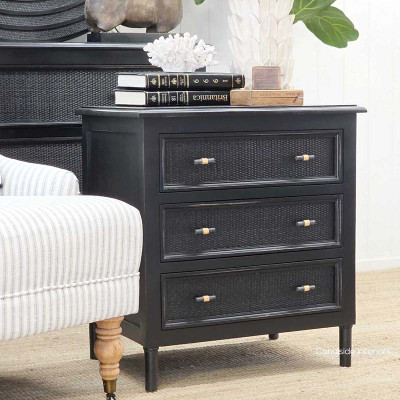
Timber brings warmth and durability, and ages well over time, though unsealed finishes can mark more easily than sealed ones. Rattan detailing, adds texture and a relaxed coastal feel while remaining sturdy for everyday use. Metal and glass are easy to wipe clean and suit a more contemporary bedroom, while being naturally spill friendly. If storage is a priority, drawers are best for hiding chargers and small items out of sight, while open shelving keeps a smaller room feeling lighter and less heavy.
It is also worth thinking about how the material will hold up, since a bedside table sees different wear than most other furniture. Water rings from glasses, the constant use of drawers each night, and the occasional dropped phone or book are all realistic scenarios, so a durable finish with a bit of everyday resilience will generally outlast a more delicate one, even if the delicate option looks more striking in a showroom.
8. Common Sizing Mistakes to Avoid
- Ignoring height alignment. A table that is noticeably taller or shorter than your mattress makes everyday use awkward, even if it looks fine in a showroom.
- Choosing a table too large for the space. A generously sized table with lots of storage can end up blocking a walkway or a wardrobe door once it is actually in the room.
- Going too small. A dainty table beside a king bed can look like an afterthought and may not have enough surface for a lamp, book, and glass of water.
- Not accounting for drawers. A table pushed too close to the bed can mean drawers cannot open fully, which quickly becomes irritating.
- Buying without measuring first. Guessing at size rather than measuring the floor to mattress height and the available floor space is the single easiest mistake to avoid.
|
Browse our full range of bedside tables to find the right size for your bedroom. |
Frequently Asked Questions About Bedside Table Height and Sizing
Q: How tall should a bedside table be? |
| A: A bedside table should sit roughly level with the top of your mattress, within about 5cm either way. Most fall between 45cm and 70cm high, depending on your bed's height and profile. |
Q: What are standard bedside table dimensions? |
| A: Standard bedside tables typically measure 45cm to 70cm in height, 40cm to 60cm in width, and 30cm to 45cm in depth, though the ideal size depends on your bed size and room layout. |
Q: How wide should a bedside table be for a queen bed? |
| A: For a queen bed, aim for a bedside table between 45cm and 55cm wide. This gives enough surface space for a lamp and everyday essentials without crowding the bed. |
Q: Do I need one bedside table or two? |
| A: For a single or king single bed, one table is usually enough. For a double, queen or king bed shared by two people, two tables, one on each side, are generally recommended for both symmetry and practicality. |
Q: How much space should I leave beside my bed for a bedside table? |
| A: Aim for at least 50cm to 60cm of clear walkway beside your bed and bedside table, so you can move around comfortably, especially at night. |
Q: Should my bedside tables match my bed frame? |
| A: Not necessarily. Matching timber tones or a shared style creates a cohesive look, but contrast can work well too, focus more on matching the proportion and scale of your bed than on identical materials. |