
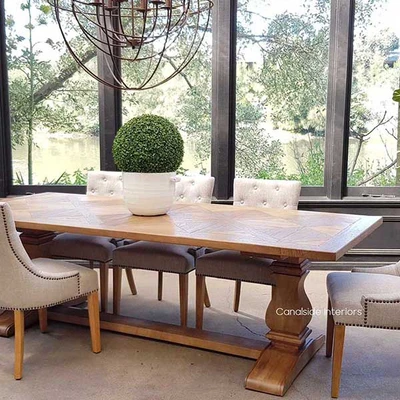
Contemporary Dining Room Ideas for a Considered Space
Canalside Interiors on 3rd Sep 2026
A contemporary dining room is about clean lines and considered proportions, balanced with enough warmth and texture that the room still feels like a space people actually inhabit.
This guide walks through the furniture, lighting, colour and layout choices that make a contemporary dining room feel both current and comfortable, whether you are working with a dedicated dining room or an open plan space that needs to earn its place within a larger area.
1. Choosing a Table and Chairs That Feel Contemporary
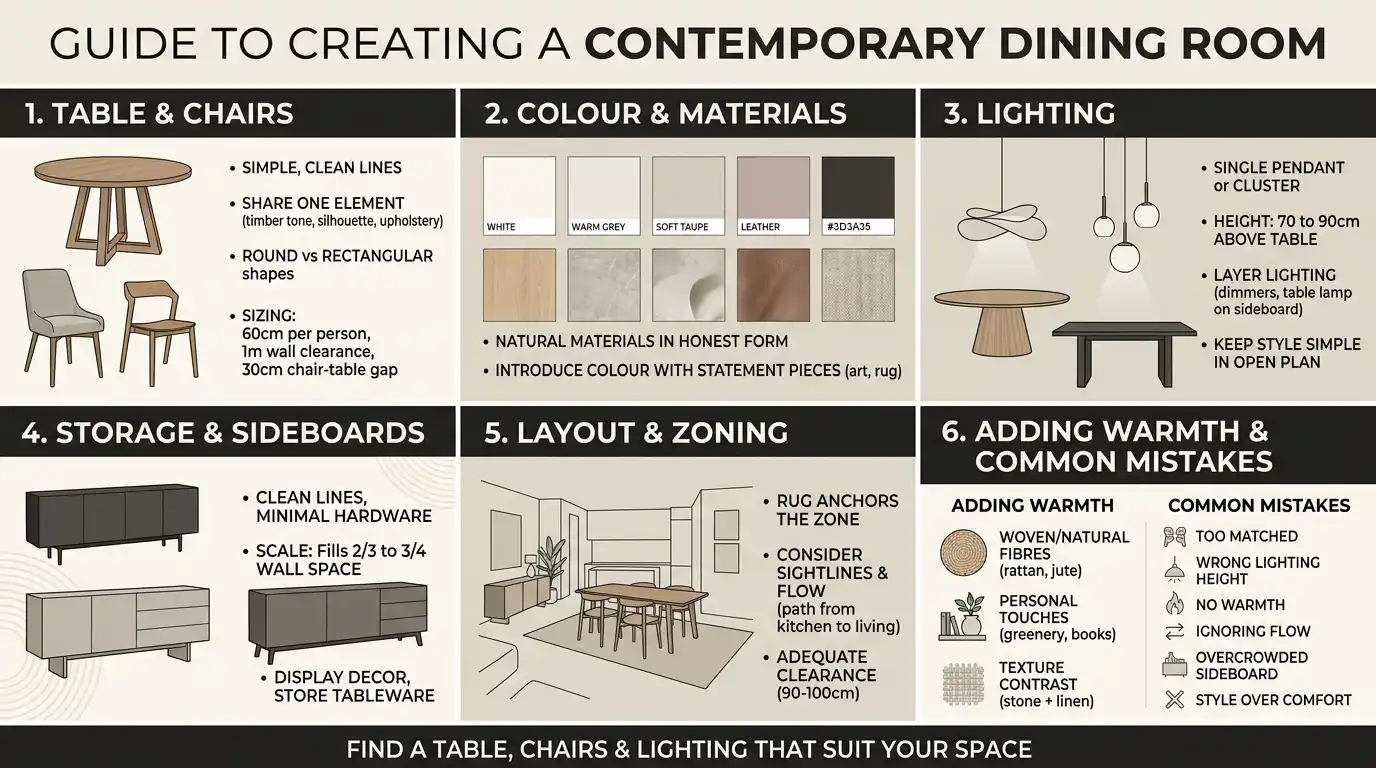
It is the dining table that sets the tone for the whole room, so it is worth starting here. A modern dining table typically favours simple, clean lines over heavily turned legs or ornate detailing.
Chairs are where a lot of contemporary dining rooms can lose their way. Choosing chairs that share one element, be it timber tone, a similar silhouette, or a consistent upholstery colour, while allowing some variation in material or shape, is a good way of incorporating contemporary design, into your dining room space.
Table shape also plays a big role in the overall cohesion of a space. A round or oval table softens a room with a lot of hard lines and straight edges elsewhere, while a rectangular table with a thin, sculptural base suits a longer, narrower room and reinforces the clean geometry that defines contemporary spaces. If your dining room needs to flex between everyday use and larger gatherings, a well-designed extension table keeps the modern silhouette intact even when extended, which is worth checking for specifically if you entertain regularly.
Sizing matters just as much as shape. As a general guide, allow at least 60cm of table space per person, and leave a minimum of 1-metre between the table and any wall or nearby furniture so that people can move freely about the space. For chairs, the gap between the top of the seat and the underside of the tabletop should be around 30cm, and it is worth avoiding chairs narrower than 45cm, since anything tighter starts to feel cramped over a longer meal.
2. Colour and Material Choices
A restrained colour palette is one of the defining features of a contemporary dining room. Rather than introducing colour through paint, most contemporary dining spaces lean on a neutral bas of whites, warm greys and soft taupe, which otherwise lets the materials chosen, do the visual work instead.
Natural materials in their honest, unadorned form read as contemporary in a way that heavily lacquered or ornately finished pieces do not. A light oak or walnut table, a stone or ceramic tabletop, and woven or leather upholstery all bring warmth and texture without tipping into a more traditional or heavily styled look. If you want to introduce a stronger colour moment, a single statement element, a piece of art, a rug, or a set of dining chairs in a deeper tone, tends to work better than spreading colour across multiple pieces.
3. Lighting for a Contemporary Dining Room
Lighting does more to define a contemporary dining room than almost any other single element. A single, well-proportioned pendant or a cluster of smaller pendants hung at the correct height, generally 70 to 90cm above the tabletop, immediately signals a considered, contemporary space.
Sculptural or minimalist pendant shapes, rather than ornate chandeliers, suit the modern aesthetic best. If your dining area shares space with a living room, keeping the pendant style simple enough that it does not compete with other light fixtures in the room helps the whole space read as a cohesive, planned layout rather than a collection of separate design decisions.
Beyond the main pendant, layering in a secondary light source makes a genuine difference to how the room feels in the evening. A dimmer on the main pendant lets you shift from bright, functional lighting for everyday meals to a softer, warmer glow for entertaining, without needing to change the fixture itself. If your dining room sits near a sideboard, a small table lamp adds a pool of ambient light that keeps the space from feeling flat once the sun goes down, and it is a simple, low-cost way to add another layer of warmth to the room.
4. Storage and Sideboards
A sideboard or buffet is one of the most useful additions to a contemporary dining room, offering storage for tableware, while doubling as a display surface for styled decor. Look for a piece with clean lines and minimal hardware, push-to-open drawers or slim integrated handles keep the look streamlined.
Scale matters as much as style when choosing a sideboard for a contemporary dining room. A piece that is too small for the wall it sits against can look like an afterthought, while one that is too large can crowd the space and make the room feel smaller than it is. As a rough guide, aim for a sideboard that fills roughly two thirds to three quarters of the available wall space, leaving enough breathing room on either side that the piece reads as a considered addition rather than something wedged into place.
5. Layout for Living and Dining Combined Spaces
Many contemporary Australian homes use an open plan layout, which means the dining room often needs to visually separate itself from the living area without a wall to do the work. This is especially common in newer builds and open-plan renovations of older terraces. A rug underneath the dining table is one of the simplest ways to define the zone, anchoring the table and chairs as their own distinct space within a larger room.
Sightlines matter too. Position the dining table so it does not block the natural path between the kitchen and living area, and leave enough clearance, ideally 90 to 100cm, around the table for chairs to be pulled out comfortably without bumping into other furniture.
6. Adding Warmth Without Losing the Contemporary Feel
The risk with a contemporary dining room is that a strict focus on clean lines can make the space feel cold or unlived in. A few deliberate choices keep the space feeling warm and coy without compromising the contemporary look.
A woven or natural fibre element, whether that is a rattan chair, a jute rug, or a woven pendant shade, softens hard lines and adds tactile warmth. Layering in a few personal or organic touches on the table or sideboard, a vessel with greenery, a stack of well-chosen books, keeps the room from feeling like a showroom display rather than a home.
Texture is doing a lot of the quiet work here. A smooth stone tabletop paired with a bouclé or linen seat cushion, or a sleek metal chair frame beside a rough-hewn timber sideboard, creates the kind of contrast that makes a room feel rich rather than flat. The goal is not to add more objects, but to make sure the objects and surfaces already in the room are talking to each other through texture as much as through colour or shape.
7. Common Mistakes in Contemporary Dining Rooms
- Too matched. A table and chair set that is entirely uniform in material and finish can read as sterile rather than considered.
- Lighting hung too high or too low. Pendant lighting outside the 70 to 90cm range above the table throws off the proportions of the whole room.
- No warmth at all. Leaning too heavily into hard materials and cool tones without any natural texture can leave a room feeling unfinished.
- Ignoring flow. In open plan spaces, a poorly positioned table can block movement between the kitchen and living area.
- Overcrowding the sideboard. A cluttered display surface undercuts the restrained, considered look a contemporary dining room is going for.
- Choosing style over comfort. A visually striking chair that nobody wants to sit in for more than twenty minutes defeats the purpose of a dining room built for gathering.
8. A Worked Example: Furnishing an Inner-City Terrace
To bring these principles together, take a genuinely common Australian scenario: a single-fronted terrace in Sydney's Inner West, recently renovated to open the kitchen through into a combined living and dining space at the rear of the house.
The dining zone measures 3.6m by 3.2m, sitting between the kitchen island and a pair of glass doors leading to a small courtyard. The owners want to seat six people comfortably most nights, with the option to squeeze in eight for a dinner party.
- Table. A rectangular extension table, 160cm as standard and 210cm extended, keeps the clean lines of the room intact while allowing that occasional eight-seat capacity. Allowing 60cm per person, six people need 360cm of table edge across both long sides, comfortably covered at the standard 160cm length with two seats at each end.
- Chairs. Four upholstered dining chairs in a soft bouclé, paired with two timber carvers at each end, adds just enough material contrast without breaking the room's restrained palette.
- Clearance. With the table centred in the 3.2m width of the zone, that leaves roughly 100cm on the kitchen-island side and 100cm on the courtyard-door side, enough for chairs to be pulled out fully and for the doors to open without obstruction.
- Lighting. A single sculptural pendant, hung 75cm above the tabletop, sits low enough to feel intimate over the extended table while still clearing sightlines to the kitchen for anyone moving through the space.
- Zoning. A jute rug under the table, sized roughly 250cm by 350cm to extend beyond the chairs on all sides even when extended, visually separates the dining zone from the kitchen without needing a wall to do it.
The result is a dining space that works for a quiet Tuesday dinner for two and a full table for eight, without needing to compromise on the clean, contemporary look the rest of the renovation is built around.
Frequently Asked Questions About Contemporary Dining Rooms
Q: What makes a dining room feel contemporary? |
| A: A contemporary dining room favours clean lines, a restrained colour palette and quality materials over ornate detailing, with understated lighting and a few well-chosen decorative pieces rather than a fully accessorised table. |
Q: How high should a pendant light hang above a dining table? |
| A: As a general guide, hang a pendant light 70 to 90cm above the tabletop. This keeps the light at a comfortable height for the table while still feeling proportionate to the room. |
Q: Do dining chairs need to match in a contemporary dining room? |
| A: Not necessarily. Chairs that share one element, such as timber tone or upholstery colour, while varying slightly in material or shape, often look more considered than a fully matched set. |
Q: How do I define a dining area in an open plan living space? |
| A: A rug underneath the dining table is one of the simplest ways to visually separate the dining zone from the rest of an open plan room, anchoring the table and chairs as their own distinct space. |
Q: How do I keep a contemporary dining room from feeling cold? |
| A: Add natural texture through materials like rattan, timber or woven fibres, and layer in a few personal or organic touches such as a vessel with greenery or a stack of books, to keep the space feeling lived in. |
Q: What is a good clearance around a dining table? |
| A: Aim for 90 to 100cm of clearance around the table so chairs can be pulled out comfortably and guests can move around without bumping into other furniture. |
Not Sure What Will Work in Your Space?
Whether you are furnishing an open-plan renovation, a period dining room, or something in between, our team at Canalside works through these decisions with customers every week. Bring your room measurements into the showroom at 38 Burrows Rd, Alexandria NSW, or call us on (02) 9565 2390. We are open seven days and happy to help you find a table, chairs and lighting that genuinely suit your space.
Browse the full dining tables, dining chairs and sideboards range online.