
Floor Lamps in Living Room Spaces: Best Styling Ideas
Canalside Interiors on 11th Feb 2025
Floor lamps in living room spaces do more work than most people give them credit for. A ceiling light alone rarely creates the kind of warm, layered glow that makes a living room feel finished, and that is exactly the gap a good floor lamp fills. Whether you need a reading light beside an armchair, a soft ambient glow for evenings on the sofa, or simply something to brighten up a dark corner, the right floor lamp changes how a room feels far more than its size would suggest.
This guide covers the different types of floor lamps worth considering, where to place them, a few genuinely distinctive styles, and how to layer them with your other lighting.
| What is the best floor lamp for a living room? The right floor lamp for a living room depends on what you need it to do. Ambient lamps with diffused shades suit general lighting, task lamps with adjustable heads suit reading nooks, and statement pieces work as decorative focal points. Place it beside the sofa or an armchair for practical use, or in a dark corner to fill an underlit space, and layer it with other light sources rather than relying on it alone. |
1. Types of Floor Lamps for the Living Room
Choosing the right floor lamp starts with understanding what job you actually need it to do, since ambient, task and accent lighting each solve a different problem in a living room.
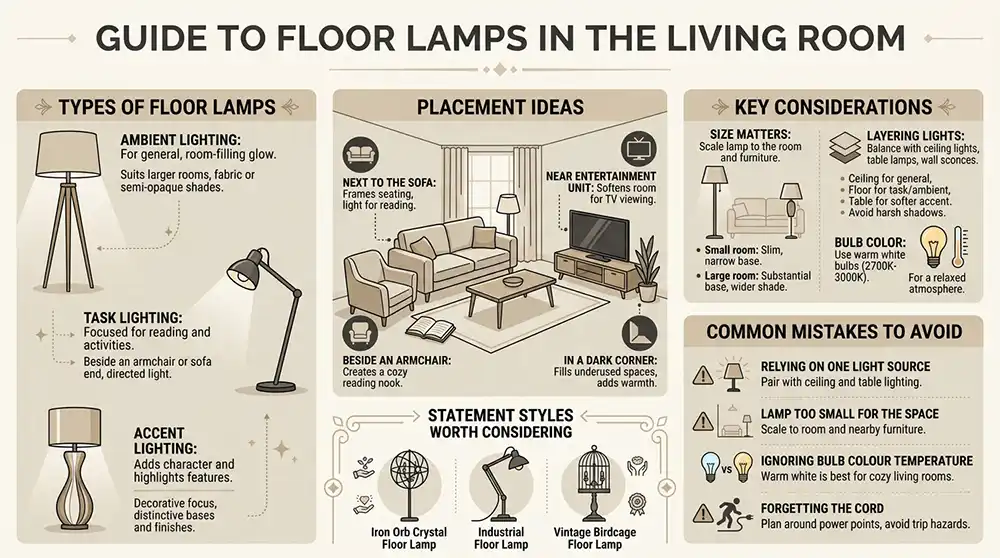
Ambient Lighting
Ambient floor lamps provide general, room-filling illumination, and work best with large, diffused shades that spread light evenly rather than casting it in one direction. These suit larger living rooms particularly well, where a single ceiling fixture often cannot reach every corner on its own. A fabric or semi-opaque shade softens the light and helps avoid the harsh shadows that a bare or narrow shade can create.
Task Lighting
Task lamps are built for a specific activity, most commonly reading, and typically feature an adjustable arm or head so the light can be directed exactly where it is needed. These work particularly well beside an armchair or at the end of a sofa, giving you focused, bright light without needing to switch on overhead lighting for the whole room.
Accent Lighting
Accent floor lamps are chosen as much for their design as their output, used to highlight artwork, a favourite corner, or simply to act as a striking piece in their own right. These lamps tend to have more distinctive bases and finishes, since their decorative role matters as much as the light they cast.
Most living rooms benefit from a mix of these rather than committing to just one type. A single ambient floor lamp handling general lighting, paired with a smaller task lamp near a reading chair, covers both the practical and atmospheric sides of a room's lighting without needing an elaborate setup.
2. Where to Place a Floor Lamp in the Living Room
Placement has as much impact on how well a floor lamp works as the lamp itself. A few positions come up again and again in living rooms that get the lighting right.
Next to the Sofa
A floor lamp beside the sofa is one of the most reliable placements, framing the seating area while providing light for reading or relaxing in the evening. If the sofa sits against a wall, a slim lamp with a narrow base avoids feeling cluttered. For sectional sofas, positioning an arched lamp at the corner can light the whole seating area without needing a second fixture.
Beside an Armchair
Pairing a floor lamp with an armchair creates an obvious, well-used reading nook, especially with a lamp that has an adjustable or directional head. Add a small side table to the same spot and you have a genuinely functional corner, somewhere to rest a book and a cup of tea as well as read comfortably.
Near the Entertainment Unit
A floor lamp near the entertainment unit can soften the room for evening television without the glare of overhead lighting. Look for a lamp with a dimmable option, and position it slightly behind or to the side of the seating area rather than directly opposite the screen, to avoid reflections and glare.
In a Dark Corner
Most living rooms have at least one corner that feels a little underused or dim. A tall floor lamp with a diffused shade fills exactly that kind of gap, adding warmth to the room without needing to rearrange any furniture. This works especially well in larger or open-plan living rooms, where a central light fixture rarely reaches every edge of the space.
A dark corner is also a practical spot to place a more decorative or statement floor lamp, since it gets to stand somewhat on its own rather than competing visually with the sofa, coffee table and other furniture already anchoring the main seating area.
3. Statement Styles Worth Considering
Once you know the type and placement that suits your space, a floor lamp is also a genuine opportunity to add character to a living room, not just fill a lighting gap.
A crystal floor lamp with a sculptural, orb-shaped frame brings a refined, slightly dramatic edge to a living room, particularly effective as a statement piece beside a sofa or in a reading corner where its detail can actually be appreciated up close. For a room already leaning toward industrial or French-inspired styling, a rust-framed floor lamp with faceted crystal detailing bridges vintage charm with a slightly more rugged, textural finish, well suited to a Hamptons or coastal-industrial living room.
For something more unexpected, a birdcage-style floor lamp with handcrafted metalwork and crystal glass makes a genuinely memorable centrepiece, the kind of lamp that becomes a talking point in its own right rather than simply blending into the room. These distinctive pieces work best as a single statement rather than layered with several other bold pieces, letting the lamp itself be the feature.
Handcrafted lamps like these also tend to carry small variations from piece to piece, a slightly different crystal arrangement or a unique patina on the metal finish, which is part of what makes them feel less like a mass-produced fixture and more like a genuine design object. If a fully matching, uniform look is the priority, a simpler ambient or task lamp is the safer choice, but for a living room that wants a real point of interest, that individuality is exactly the appeal.
|
Explore statement floor lamps: Discover the Foucault Iron Orb Crystal Floor Lamp, the Florian Industrial Floor Lamp, and the Vintage Birdcage Floor Lamp, or browse Canalside's full lighting and lamps range. |
4. Layering Floor Lamps With Other Lighting
A single floor lamp, however well chosen, rarely does its best work alone. Combining it with other light sources, ceiling lights, table lamps and wall sconces, creates a more balanced, dynamic room than relying on one fixture to do everything.
A simple layering approach uses ceiling lighting for general illumination, a floor lamp for task or ambient lighting in a specific zone, and a table lamp for a softer accent elsewhere in the room. This combination reduces harsh shadows and gives you more control over the mood at different times of day, bright and functional in the afternoon, warmer and dimmer in the evening.
Where possible, choose a floor lamp with a dimmable option or compatible smart bulb, since this adds flexibility without needing a second lamp for a softer setting. Warm white bulbs, generally in the 2700K to 3000K range, tend to suit living rooms best, creating a relaxed atmosphere that cooler bulbs can struggle to match.
5. Choosing a Floor Lamp for Your Living Room Size
Scale matters more than most people expect when choosing a floor lamp, and getting it wrong in either direction affects how the whole room feels.
In a smaller living room, a slim, narrow-based floor lamp avoids eating into walking space, and a taller design with a compact footprint tends to work better than a wide, heavy base that visually crowds the room. In a larger living room, an undersized lamp can look lost against bigger furniture, and a more substantial base or a taller design with a wider shade holds its own against a large sofa or sectional far better.
It is also worth considering the height of nearby furniture. A floor lamp placed beside a low-profile sofa should generally sit a little taller than the lamp itself needs to be for light output alone, simply so it does not disappear visually next to the furniture around it. Beside a taller armchair, a shorter lamp can work perfectly well, since the furniture already provides enough height in that part of the room.
6. Common Floor Lamp Mistakes to Avoid
A few recurring issues come up when a floor lamp does not quite work as well as it should in a living room.
- Relying on one light source for the whole room. A single floor lamp, no matter how bright, rarely lights an entire living room evenly. Pairing it with ceiling or table lighting gives a far more balanced result.
- Choosing a lamp that is too small for the space. A slim, understated lamp can get visually lost in a larger living room. Scale the lamp to the size of the room and the furniture around it.
- Ignoring bulb colour temperature. A cool white bulb in a living room lamp can feel clinical rather than cosy. Warm white bulbs generally suit living spaces better than daylight-toned ones.
- Placing a task lamp somewhere it will not get used. A reading lamp positioned away from any seating rarely earns its keep. Match the lamp's purpose to where people will genuinely sit.
- Overcrowding a statement piece. A striking, sculptural floor lamp works best with some visual space around it. Placing several bold decorative pieces nearby can compete with the lamp rather than let it stand out.
- Forgetting the cord. A trailing cord across a walkway is both a trip hazard and a styling distraction. Plan the lamp's position around the nearest power point before falling in love with a spot that will not actually work.
Frequently Asked Questions About Floor Lamps
Q: What type of floor lamp is best for a living room? |
| A: It depends on what you need it for. Ambient lamps with diffused shades suit general lighting, task lamps with adjustable heads suit reading nooks, and statement or accent lamps work well as a decorative focal point in the room. |
Q: Where should I place a floor lamp in my living room? |
| A: Common placements include beside the sofa, next to an armchair for reading, near the entertainment unit for softer evening lighting, or in a dark corner to fill an underused space. |
Q: How many floor lamps should a living room have? |
| A: Most living rooms work well with one or two floor lamps, layered alongside ceiling lighting and table lamps, rather than relying on floor lamps as the only light source in the room. |
Q: What bulb colour is best for a living room floor lamp? |
| A: Warm white bulbs, generally between 2700K and 3000K, tend to suit living rooms best, creating a relaxed, inviting atmosphere. Cooler bulbs are better suited to task-focused lighting elsewhere in the home. |
Q: Can a floor lamp be a statement piece rather than just functional lighting? |
| A: Yes. A sculptural or distinctive floor lamp, such as one with crystal detailing or an unusual frame, can act as a genuine decorative feature in a living room, not just a light source. |