
Hallway Table Decor Ideas That Work Every Day
Canalside Interiors on 18th Sep 2026
Your hallway is the first thing anyone sees when they walk through the door, and yet it is often the last space to get any real styling attention. A well-chosen hall table changes that instantly, giving the space a clear focal point and somewhere to land your keys, mail and everyday bits and pieces without them ending up scattered across the kitchen bench.
This guide covers how to choose the right hall table for your space, where else it can work beyond the hallway, what to put on it, and how to style it so it feels considered rather than like an afterthought.
| What are good hallway table decor ideas? Start with a hall table that suits the width of your hallway, add a mirror above it for both function and light, then layer in one or two functional pieces such as a tray for keys and a small vase or decorative object. Keep the number of items low so the table stays easy to use every day, not just easy to look at. |
1. Choosing the Right Hall Table for Your Space
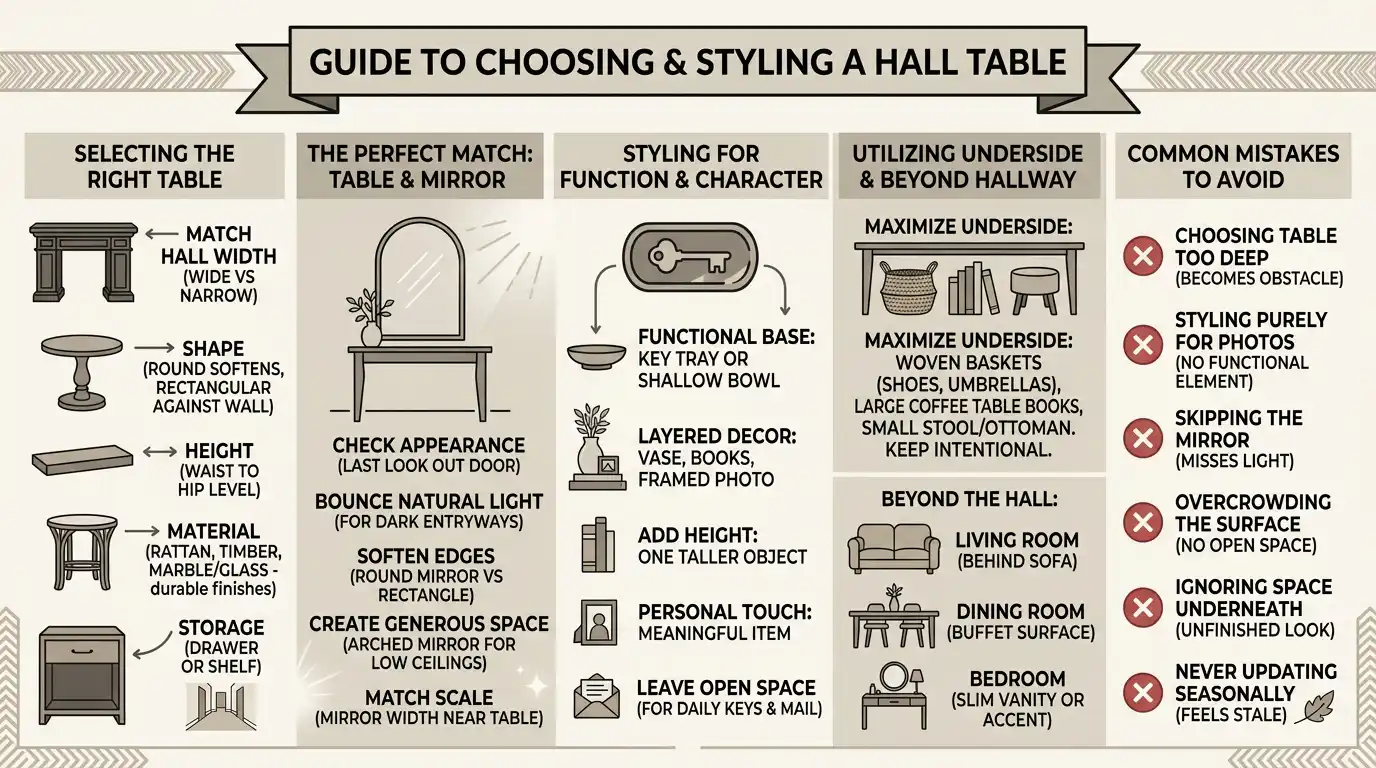
The table itself needs to suit the hallway before any styling advice matters. A wide entryway can comfortably take a substantial console table with real presence, while a narrower hallway needs something slimmer that will not eat into the walking space or become an obstacle every time someone passes through with shopping bags.
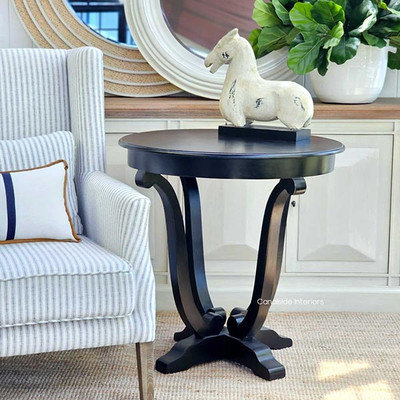
Shape is worth thinking about too. A round hall table softens a space full of straight lines and doorframes, and its lack of sharp corners makes it a safer choice in a narrow hallway where people are walking past regularly. A rectangular console suits a wider entryway where there is room to appreciate its full length, often working well against a long, blank wall.
Height matters as much as width. As a general guide, a hall table should sit somewhere between waist and hip height, tall enough to use comfortably without stooping, but not so tall that it feels like it is competing with the mirror or artwork above it. Storage is worth building in from the start rather than adding later. A hall table with a drawer or two gives you somewhere to tuck away spare keys, dog leads or anything else that would otherwise clutter the surface.
Material also plays a bigger role in a hallway than in most rooms, simply because it is the first thing people touch or brush past on their way in. A rattan or cane hall table brings a relaxed, coastal feel and tends to survive daily handling well, while a timber piece with a durable finish suits a busier household. Marble or glass-topped consoles look striking but show marks and dust more readily, worth factoring in if the table will genuinely be used every day rather than admired occasionally.
2. Where to Use It Beyond the Hallway
A hall table and a console table are, in practice, the same piece of furniture. What changes is the room it ends up in, and each location comes with its own styling considerations worth knowing about, even if the hallway remains the most common spot for one.
Behind a Sofa
Positioned behind a sofa in the living room, the same table takes on a different job, adding a display surface to a room that might otherwise only have a coffee table to work with. Styling here can lean a little fuller than in a hallway, since there is no foot traffic squeezing past it. A lamp, a stack of books and a low vase all sit comfortably here without needing to double as a catch-all for keys.
In the Dining Room
A console table along a dining room wall works well as a buffet-style surface, somewhere to rest serving dishes during a dinner party or display a few pieces of tableware the rest of the time. If the room already has dedicated storage, a sideboard or buffet often makes more sense than a console table here, since it adds the same surface with the benefit of enclosed storage underneath.
As a Bedroom Vanity or Accent
A slim console table works surprisingly well in a bedroom, either as an impromptu vanity in front of a mirror or simply as a decorative surface under a window where a full dresser would feel too heavy. A small tray, a candle and a stack of books keep it feeling calm and in keeping with the room's quieter purpose.
Wherever it ends up, the underlying table does not change. What shifts is the styling, fuller and more relaxed in a living room, restrained and functional in a hallway, softer and more personal in a bedroom.
3. Pairing Your Hall Table With a Mirror
A mirror above a hall table is one of the most reliable pairings in interior styling, and for good reason. It gives you somewhere to check your appearance on the way out the door, and it also bounces natural light back into what is often one of the darkest parts of a home.
A round mirror softens the straight edges of a rectangular console and suits most hallway styles, while a taller, arched mirror can make a low-ceilinged entryway feel more generous than it actually is. If the hallway gets very little natural light, a mirror positioned to catch whatever light does come through a nearby window or door makes a noticeably bigger difference than one placed purely for symmetry.
Scale matters here more than in most rooms. A mirror that is narrower than the table beneath it tends to look a little lost, while one roughly matching the table's width, or slightly narrower, reads as a considered pairing rather than two unrelated pieces stacked on top of each other. If a mirror is not an option, a single piece of artwork or a small gallery of framed prints above the table achieves a similar sense of a finished, anchored display.
4. Keeping It Functional, Not Just Decorative
A hallway table that only looks good in photos will not survive daily life. The most successful hall tables earn their place by solving a real problem every time someone walks through the door.
A small tray or dish for keys is the single most useful addition you can make, since it gives everyone in the household an obvious spot to drop them rather than leaving them wherever they happen to land. A shallow bowl works just as well for loose change, sunglasses or anything else that tends to accumulate near the front door. If mail is a recurring source of clutter, a designated spot on the table, even just a simple tray, stops it from spreading across the rest of the house.
This functional layer does not need to compromise the styling. A well-chosen tray or bowl is a decorative object in its own right, so the practical and the beautiful can genuinely be the same piece rather than two separate considerations.
5. Styling the Table Itself
Once the table, mirror and functional pieces are sorted, the remaining styling comes down to the same balance and layering principles that work on any surface. Choose one taller item, a small vase, a stack of books or a single decorative object, to give the arrangement some height, then group it with one or two smaller pieces rather than spreading several unrelated objects evenly across the table.
A single meaningful object, a piece picked up while travelling, a framed photo or a small handmade item, adds more character than a table styled entirely from matching store-bought pieces. Leave some open space around whatever you choose as well. A hall table that is completely covered starts to compete with its own function, since there needs to be room left for the keys and mail that will land on it daily.
For a deeper dive into building out a fuller console table display with pots, vases and layered decor, our console table decor ideas guide covers the full styling formula in more depth.
|
Find the right piece for your hallway: Explore the Downton Round Hall Table, the Laguna Hampton 3 Drawer Console, the Hampton Avenue Console, or browse Canalside's full range of mirrors to complete the pairing. |
6. What to Put Below the Table
The space underneath a hall table is easy to overlook, but it is doing just as much work as the surface on top when it comes to keeping the space both styled and functional.
Woven baskets are the most useful addition here, giving you somewhere to slide shoes, umbrellas or spare blankets out of sight without needing a dedicated cupboard. A stack of larger coffee table books can ground a taller, narrower table visually, filling what would otherwise be an empty gap beneath it. If the table has the clearance for it, a small stool or ottoman tucked underneath adds occasional extra seating, useful for putting on shoes, while staying out of the way the rest of the time.
Whatever you choose, keeping the area beneath the table intentional rather than a dumping ground for whatever does not fit elsewhere makes a real difference to how finished the whole piece feels, not just the surface on top.
7. Seasonal Styling Swaps
One of the easiest ways to keep a hall table feeling current without buying new furniture is to adjust the styling with the seasons. A few small changes can shift the whole feel of the space without touching the table itself.
In warmer months, lighter tones, fresh or faux greenery and simpler, airier arrangements suit the season well. As the weather cools, swapping in richer tones, a scented candle and slightly fuller styling brings a cosier feel heading into the colder months. Around the festive season, this is often the one spot in the home that gets a dedicated seasonal refresh, a small wreath leaned against the mirror or a few festive accents layered in alongside the everyday pieces.
Because the underlying setup, the table, the mirror, the functional tray, stays the same, a seasonal refresh only ever takes a few small swaps rather than restyling the whole space from scratch.
8. Working With a Narrow Hallway
Narrow hallways come with their own set of rules, since there is usually very little room either side of a table before it starts to interfere with foot traffic. A slim, narrow-depth console or a round table with a small footprint are both safer choices than a deep rectangular piece, which can make an already tight space feel more cramped.
Wall-mounted or floating console designs are worth considering if the hallway is genuinely tight, since they free up floor space entirely while still giving you the same surface for styling and storage. If a full table simply will not fit, a slim wall shelf can do a scaled-down version of the same job, a small tray, a single decorative object and a spot for keys, without needing floor space at all.
Lighter finishes also help a narrow hallway feel less closed in. A pale timber or rattan table reflects more light than a dark, heavy piece, which can make a real difference in a space that already gets limited natural light from a front door and not much else.
9. Common Hallway Table Mistakes to Avoid
A few recurring issues come up when a hallway table does not quite work as well as it should.
- Choosing a table that is too deep for the space. A console that juts too far into a narrow hallway becomes an obstacle rather than a feature. Measure the walkway width before committing to a piece.
- Styling it purely for photos. A table with no functional element, no tray, no obvious spot for keys, tends to accumulate random clutter anyway, just without any system to it.
- Skipping the mirror. A hall table on its own does half the job a table and mirror pairing does, particularly in a dim entryway that benefits from the extra reflected light.
- Overcrowding the surface. A hallway table gets used daily, so it needs some open space left for whatever lands on it that day, not just what was there when it was styled.
- Ignoring the space underneath. An empty, unstyled gap below the table can make the whole piece feel unfinished, especially on a taller, narrower design where the gap is more noticeable.
- Never updating it seasonally. A hall table styled once and never touched again can start to feel stale. Small seasonal swaps keep it feeling current with very little effort.
Frequently Asked Questions
Q: What should I put on a hallway table? |
| A: A mix of functional and decorative items works best. A tray or bowl for keys, a small vase or decorative object for height, and one or two personal pieces such as a framed photo strike a good balance between usefulness and style. |
Q: Can a hall table be used in other rooms besides the entryway? |
| A: Yes. The same style of table works well behind a sofa in the living room, along a dining room wall as a buffet-style surface, or as a slim accent piece in a bedroom. The table stays the same, but the styling shifts depending on the room. |
Q: Should I always put a mirror above a hallway table? |
| A: It is not essential, but it is one of the most effective pairings for a hallway specifically, since it adds both function and reflected light to what is often a darker part of the home. If wall space or hanging is not an option, the table can still work well on its own. |
Q: What size hall table do I need for a narrow hallway? |
| A: Look for a slim, narrow-depth console or a round table with a small footprint. Leave enough clearance on either side for comfortable foot traffic, and consider a wall-mounted or floating design if the hallway is particularly tight. |
Q: What goes underneath a hall or console table? |
| A: Woven baskets for shoes or spare items, a stack of larger books, or a small stool or ottoman if there is enough clearance. Keeping this space intentional rather than a dumping ground makes the whole piece feel more finished. |
Q: What is the difference between a console table and a hall table? |
| A: In practice, the terms are used interchangeably. A hall table typically refers to a console positioned in an entryway or hallway specifically, while console table is the broader term for the same style of freestanding, desk-height furniture piece used against a wall. |