
How to Choose Dining Chairs for Your Australian Home
Canalside Interiors on 1st May 2026
The dining room is one of the most well-used spaces in any Australian home. It's where the family comes together for weeknight dinners, where friends gather for long Sunday lunches, and where the conversation flows well into the evening. Yet when it comes to furnishing this space, dining chairs are often an afterthought, chosen quickly, without enough consideration for how they'll feel after an hour at the table.
Knowing how to choose dining chairs that genuinely suit your home takes a little more thought than simply picking a style you like. The right chair needs to be the correct height, made from the right materials for your lifestyle, comfortable enough for long meals, and in keeping with the overall aesthetic of your home. Get it right, and your dining room becomes a space people genuinely want to linger in. Get it wrong, no amount of beautiful styling will make up for chairs that feel uncomfortable or look out of place.
This guide walks you through everything you need to know about how to choose dining chairs for your Australian home, from sizing and materials to whether they should match your table, style, comfort, and care. Whether you're after the relaxed elegance of Hamptons dining chairs, the warmth of timber, or the effortless coastal feel of rattan, this guide will help you make a confident, informed decision.
| What should I look for when choosing dining chairs? The most important factors are seat height (to match your table), seat width and depth (for comfort), frame material (for durability), back support (for longer meals), and overall style (to suit your home's aesthetic). For Australian homes, it's also worth considering how the chairs will hold up in our climate, particularly in coastal settings where humidity and salt air can affect certain materials. |
1. How to Choose Dining Chairs: Get the Sizing Right Before Anything Else
Before you fall in love with a particular style or finish, sizing has to come first. The most common, and most frustrating, mistake Australians make when figuring out how to choose dining chairs is buying chairs that don't properly fit their table. A beautiful chair is useless if it's the wrong height or too wide for the space.
Seat Height
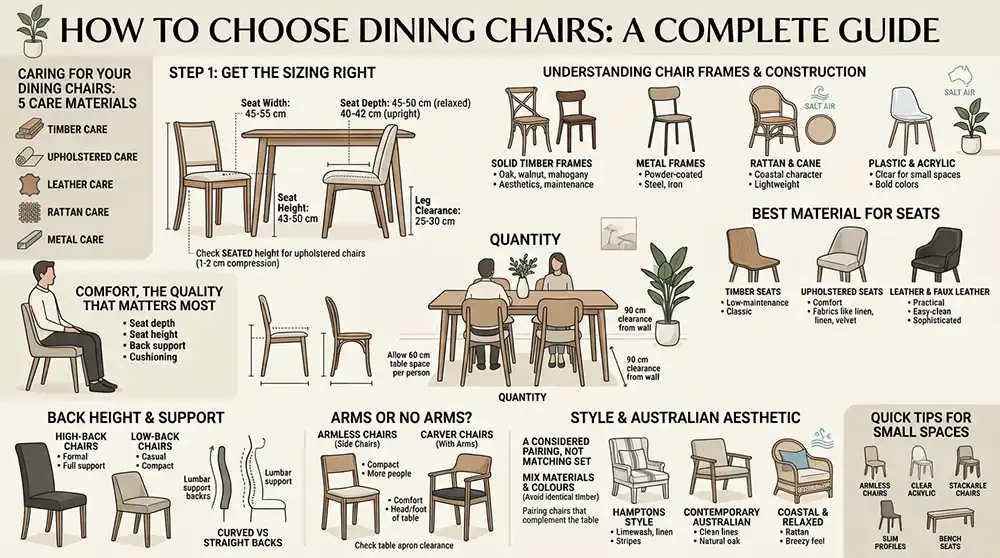
The standard dining table in Australia sits at approximately 71 to 81 centimetres high. For a comfortable fit, your dining chair seat should sit between 43 and 50 centimetres from the floor, leaving a clearance of around 25 to 30 centimetres between the seat and the underside of the table. This gap gives your legs room to move freely and allows you to sit in a natural, upright posture without hunching or straining.
For a thorough reference on standard dining chair dimensions, Dimensions.com provides a comprehensive international design guide. If you're considering upholstered chairs, keep in mind that a padded seat will compress by approximately 1 to 2 centimetres once you sit on it. Most manufacturers account for this by designing upholstered seats slightly higher than their timber counterparts. Always check the seated height, not just the listed seat height, when shopping.
Seat Width
A seat width of 45 to 55 centimetres suits most adults comfortably. Narrower chairs can feel cramped, particularly for broader guests, while chairs that are too wide can crowd a table and reduce the number of people you can seat. In Australian open-plan homes, where the dining area often flows directly into the kitchen or living space, keeping the chair footprint proportionate is especially important.
Seat Depth
Seat depth is one of the most overlooked dimensions when choosing dining chairs, yet it makes a significant difference to how comfortable a chair actually feels. A deeper seat, around 45 to 50 centimetres, suits taller individuals and gives a more relaxed posture. A shallower seat of around 40 to 42 centimetres encourages a more upright position, which suits shorter people or those who prefer formality at the table. If possible, visit our Alexandria showroom and sit in the chairs you're considering, five minutes in person tells you far more than any specification.
2. Understanding Chair Frames and Construction
The frame of a dining chair determines both its character and its longevity. A well-constructed frame should feel solid and stable, no wobbling, no flex, no creaking under your weight. When assessing quality, press down on the seat and gently rock the chair side to side. Any movement or give is a warning sign.
Solid Timber Frames
Timber is the most enduring material choice for dining chair frames, and timber dining chairs remain the most popular option in Australian homes for good reason. Solid oak, walnut, and mahogany frames are hardwearing, age gracefully, and carry a warmth that suits both contemporary and traditional interiors. Timber can be painted, stained, oiled, or left natural, making it one of the most versatile frame options available. For Australian Hamptons-style homes in particular, white-painted or limewash timber frames are a classic choice that pairs beautifully with linen upholstery and the coastal palette that defines this beloved Australian style.
Metal Frames
Metal-framed dining chairs, typically in powder-coated steel, blackened iron, or brushed stainless steel, bring a contemporary or industrial edge to a dining room. They're extremely durable, require minimal maintenance, and are well-suited to high-traffic households. Many metal-framed chairs are paired with an upholstered or cushioned seat for comfort, combining the structural strength of metal with a softer seated experience.
Rattan and Cane
Rattan dining chairs have had a genuine resurgence in Australian interiors over the past few years, and they show no sign of slowing down. Lightweight, tactile, and full of coastal character, rattan chairs suit the relaxed aesthetic of Australian homes particularly well, whether that's a Hamptons-style dining room, a beachy Queensland Queenslander, or a light-filled Sydney terrace.
Our Noda Oak Rattan Dining Chair combines a solid oak frame with a handwoven rattan back, delivering both durability and that effortless, lived-in coastal style so many Australians love. Rattan does require a degree of care in very humid or coastal environments, avoid prolonged exposure to direct sunlight or excessive moisture, but with basic maintenance, quality rattan chairs will last for many years.
Plastic and Acrylic
For casual dining spaces or smaller rooms, clear acrylic chairs are worth considering. Their transparency creates an illusion of space and openness, particularly useful in apartments or dining nooks where the room can't afford to feel heavy or dark. Bold-coloured plastic chairs can also add a playful, contemporary energy to a casual dining area and are incredibly easy to wipe clean.
3. Choosing the Best Material for Dining Chair Seats
Beyond the frame, the seat material has a direct impact on both comfort and practicality, particularly in Australian households where dining chairs are used daily and need to withstand everything from family dinners to homework sessions and weekend entertaining. Understanding seat materials is a key part of knowing how to choose dining chairs that will stand the test of time.
Timber Seats
All-timber dining chairs are the most low-maintenance option available. They're easy to wipe clean, age well, and carry a classic, unfussy quality that suits a wide range of interiors. The trade-off is that they offer no inherent cushioning, so they're best suited to shorter meals or spaces where style takes priority over extended sitting comfort. A removable seat cushion is a simple way to add comfort without changing the look.
Upholstered Seats and Backs
Upholstered dining chairs are the most popular choice for Australian homes that prioritise comfort, and they're the signature choice for Hamptons-style interiors. Fabric options range from natural linen and cotton to velvet and performance fabrics, stain-resistant and ideal for families with children. Our Leclerc Dining Chair in Cream is a perennial favourite, a generously padded upholstered seat and back on solid timber legs that works equally well in contemporary and classic Australian dining rooms. If you have young children or pets, choose a performance fabric or leather upholstery that can be wiped clean easily.
Leather and Faux Leather
Leather dining chairs bring a sense of quiet sophistication to a dining room and are genuinely one of the most practical upholstery choices for busy Australian households. Spills wipe away with a damp cloth, crumbs don't embed in the surface, and quality leather only improves with age. Faux leather, sometimes called vegan leather, offers a similar look and equally easy maintenance at a more accessible price point, a smart choice for families.
4. Back Height and Support
Back support is something many people overlook when working out how to choose dining chairs, yet it's one of those things you don't notice until it's wrong. After 45 minutes at the table, a chair with poor back support will make itself very well known. When assessing chairs, consider both the height of the back and its shape.
High-Back Chairs
High-back dining chairs have a formal, considered quality that suits statement-making dining rooms. They provide full spinal support along the length of the back, making them considerably more comfortable for extended meals. In Hamptons-style interiors, a high-back upholstered chair in linen or a classic stripe adds an elegant, layered look to the dining table.
Low-Back and Mid-Back Chairs
Low-back and mid-back chairs are a better fit for casual dining rooms, compact spaces, or interiors where a high back would feel visually overwhelming. They're lighter in visual weight, easier to move around, and often more versatile when mixing and matching different styles around the one table.
Curved vs Straight Backs
A curved or contoured backrest gently follows the natural shape of the spine, providing better lumbar support for longer meals. If your dining room doubles as a work-from-home space, as many Australian dining rooms do, a chair with good lumbar support is particularly worth prioritising. Straight backs have a cleaner, more architectural appearance that suits contemporary and minimalist dining rooms.
5. Arms or No Arms? Understanding Carver Chairs
One of the most practical decisions when working out how to choose dining chairs is whether to go with arms or without, which affects both the comfort and the layout of your dining room.
Armless Dining Chairs
Armless dining chairs, sometimes called side chairs, are the most common choice for Australian dining rooms. They're compact, easy to slide under the table when not in use, and allow you to seat more people around the table. If you love to entertain and regularly host larger groups, dining chairs without arms give you the most flexibility and the most seats per metre of table.
Carver Chairs (Dining Chairs With Arms)
Carver chairs are armchairs designed specifically for the dining table. Positioned at the head and foot of the table, they add a layer of comfort and a sense of occasion. In Hamptons-style dining rooms, they're something of a signature piece. Browse our dining chairs with arms for options that work beautifully as carver chairs in both contemporary and classic Australian interiors. Always check that the armrest height clears your table's apron before purchasing.
6. Should Dining Chairs Match the Table?
This is one of the questions we hear most often, both online and in our Alexandria showroom, and the honest answer is that they don't need to. In fact, a table and chairs that are too closely matched can end up feeling flat rather than considered.
Why Perfectly Matched Sets Can Fall Short
Package deal dining suites became popular because they removed the guesswork, you knew the table and chairs would fit together, both in size and finish. The trade-off is that an identical table and chair set can look uninteresting, particularly when both pieces share the exact same timber tone or material. A dining table and its chairs work better as a considered pairing than a matching set, related, but each bringing something slightly different to the room.
Mixing Materials and Colours
As a general rule, avoid pairing a table and chairs in the exact same material and finish, a timber table with timber chairs in the identical stain, for example. Instead, let one piece lead and the other support it. A solid oak table paired with upholstered linen chairs creates a natural contrast, while a marble or glass table softened with timber or rattan chairs brings warmth to a harder surface.
The same logic applies to colour. A black table with charcoal chairs, or an oak table with soft beige upholstery, introduces just enough variation to avoid a matchy-matchy look without needing a bold contrast. If your flooring is a similar tone to your table, this becomes even more important, since a table, chairs and floor in near-identical colours can make a dining space feel flat and one-note. A rug underneath the table is a simple way to break this up if you're working with an existing floor colour you can't change.
Getting the Height and Proportions Right
Once you've settled on a style direction, the numbers matter just as much as the look. As a general guide, your dining chairs should sit at least 10 centimetres higher than your tabletop, measuring from the floor to the top of the chair back, so the proportions feel balanced rather than swallowed by the table. Chairs that are too short can visually disappear beneath a table with a deep apron or a thick tabletop.
Width matters too, particularly if you're buying your table and chairs from different places rather than as a set. Divide the total length of your table by the width of the chair you're considering to work out roughly how many will comfortably fit along one side, then allow at least 20 centimetres of breathing room between each chair so guests aren't elbow to elbow. Keep in mind that inset table legs can reduce the usable width along the sides, so it's worth checking the space between the legs themselves, not just the overall tabletop measurement, before finalising your chair count.
7. Style and the Australian Aesthetic
Australia has developed a distinctly local approach to interior design, one that blends coastal informality with quality craftsmanship, and a deep appreciation for natural materials and light-filled spaces.
Hamptons Style
The Hamptons aesthetic remains one of the most enduring interior styles in Australia, and the dining room is where it shines most clearly. Classic Hamptons dining chairs typically feature timber or rattan frames in white, natural oak, or limewash finishes, with upholstered seats in linen, cotton, or the signature blue-and-white stripe. If you'd like to explore the style further, our guide on what is Hamptons style covers everything from its origins to its uniquely Australian evolution.
Contemporary Australian
Contemporary Australian dining rooms tend to favour clean lines, natural materials, and a restrained palette. Timber-framed chairs in natural oak or walnut, paired with an upholstered seat in a neutral performance fabric, hit exactly the right note. The key is quality over decoration, well-made pieces in honest materials that will look as good in ten years as they do today.
Coastal and Relaxed
For homes in coastal settings, or Australian homes that simply want to capture that breezy, sun-drenched feel, rattan dining chairs are the natural choice. Light, tactile, and full of personality, they work with everything from a reclaimed timber dining table to a whitewashed oak setting.
8. Dining Chairs for Small Spaces
Not every Australian home has a dedicated dining room to work with. Knowing how to choose dining chairs for small spaces is a matter of smart planning rather than compromise.
- Armless chairs take up significantly less space than carver chairs and allow more flexibility in seating numbers.
- Clear acrylic chairs create an illusion of openness and work well in tight spaces.
- Stackable chairs can be stored away easily when not in use, ideal for dining areas that do double duty.
- Slim-profile timber chairs with a narrow footprint maximise seating without crowding the room.
- A bench seat along one side of the table can seat more people and tucks neatly under the table when not in use.
9. How Many Chairs Do You Actually Need?
Another important consideration when deciding how to choose dining chairs is quantity. It's tempting to buy for the biggest occasion you might ever host, but furnishing your dining room for everyday life rather than once-a-year entertaining will serve you far better in the long run. A family of four who eats together most nights is well served by a six-seater configuration. As a general guide, allow approximately 60 centimetres of table space per person for comfortable dining, and at least 90 centimetres of clearance between the table and any wall or nearby furniture.
10. Comfort, the Quality That Matters Most
Style, material, and price all matter when deciding how to choose dining chairs, but comfort is the single quality that will determine whether they are a genuine pleasure to use or something you quietly regret. When assessing comfort, sit in the chair for at least a few minutes. Pay attention to:
- Seat depth, are your thighs fully supported without the front edge pressing into the back of your knees?
- Seat height, does the height feel natural relative to the table?
- Back support, does the backrest make contact with your lower back?
- Cushioning, is there enough padding for extended sitting?
11. Caring for Your Dining Chairs
A quality set of dining chairs, properly cared for, should last for many years. Visit our Furniture Care guide for detailed advice specific to your Canalside pieces. As a general guide:
- Timber frames: Wipe regularly with a soft, slightly damp cloth. Re-oil or re-wax periodically to maintain the finish.
- Upholstered seats: Vacuum weekly. Blot spills immediately, never rub. Spot-clean with a mild upholstery cleaner.
- Leather and faux leather: Wipe with a damp cloth. Condition genuine leather every six to twelve months.
- Rattan and cane: Dust regularly. Keep out of prolonged direct sunlight. Clean with a lightly damp cloth and dry naturally.
- Metal frames: Wipe with a damp cloth. Check powder-coated finishes periodically for chips that can lead to rust.
|
Ready to Find Your Perfect Dining Chairs? Now that you know how to choose dining chairs that suit your Australian home, shop our dining chairs online, explore our full dining room collection, or browse our range of kitchen stools for the perfect complement to your kitchen bench. Visit us at our Alexandria showroom, we'd love to help you put it all together. |
Frequently Asked Questions About Choosing Dining Chairs
Q: What should I look for when choosing dining chairs? |
| A: Look for chairs with the correct seat height for your dining table (43 to 50 cm is standard in Australia), a seat width of 45 to 55 cm, and enough depth to support your thighs comfortably. Consider the frame material for durability, the back design for support, and the seat material for your lifestyle. Style should complement your dining room's overall aesthetic, and comfort should always be your final test. |
Q: What height should dining chairs be in Australia? |
| A: Dining chairs in Australia should have a seat height of approximately 43 to 50 cm to pair correctly with the standard dining table height of 71 to 81 cm. This leaves a clearance of around 25 to 30 cm between the seat and the underside of the table for comfortable leg movement. If choosing upholstered chairs, account for 1 to 2 cm of foam compression once seated. |
Q: What is the best material for dining chairs in an Australian home? |
| A: The best material depends on your household and lifestyle. For families with young children, leather, faux leather, or performance fabrics are the most practical. For a coastal or Hamptons aesthetic, rattan or linen-upholstered timber chairs are a natural fit. If low maintenance is the priority, a solid timber chair with a simple finish is hard to beat. |
Q: Should dining chairs match the dining table? |
| A: Not necessarily, in many Australian homes, a considered mix of styles adds character and visual interest. Rather than matching the material and colour exactly, aim for chairs that are at least 10 cm taller than the tabletop and share one common element with the table, whether that's a timber tone, a colour from the room's palette, or a shared design language. Mixing armless chairs with carver chairs at each end is a classic approach that works beautifully in Hamptons-style interiors. |
Q: What is a carver chair and do I need one? |
| A: A carver chair is a dining chair with arms, typically placed at the head and foot of the dining table. They offer more comfort than armless chairs and add a sense of formality and occasion to the dining setting. Armless chairs work perfectly well all the way around the table, but if you entertain regularly or love a considered, layered look, a pair of carver chairs is well worth the investment. Always check that the armrest height clears your table's apron before purchasing. |
Q: How much space should I allow per dining chair? |
| A: Allow approximately 60 centimetres of table length per person for comfortable dining, with at least 20 centimetres between each chair so elbows don't bump during the meal. Between the table edge and any wall or nearby furniture, aim for at least 90 centimetres of clearance so guests can push their chairs back and stand comfortably. In smaller spaces, armless chairs or a bench seat on one side of the table will help maximise seating without crowding the room. |
Q: Are rattan dining chairs suitable for an Australian coastal home? |
| A: Rattan dining chairs are one of the most popular choices for Australian coastal homes. They're lightweight, visually relaxed, and full of natural texture that suits the breezy, sun-drenched aesthetic of Australian coastal living. They work particularly well in Hamptons-style dining rooms and open-plan spaces that connect to an outdoor entertaining area. With basic care, keeping them out of prolonged direct sunlight and away from excess moisture, quality rattan chairs will last for many years. |