
How to Set a Table Setting the Right Way, for Any Occasion
Canalside Interiors on 20th Aug 2026
A well-arranged table setting can turn an ordinary meal into something that feels genuinely considered. It does not need to be elaborate or formal to make an impression; sometimes it is the smallest details, a napkin folded just so or a glass placed in exactly the right spot, that can make a table feel properly finished.
This guide covers everything from a simple everyday table setting through to a full formal layout, along with the spacing, cutlery and glassware logic that ties it all together. Whether you are setting the table for a quiet family dinner or a proper dinner party, you will find a clear approach here to suit the occasion.
| How do you set a table setting? Centre the plate in front of each chair, place the fork to the left and the knife and spoon to the right with the knife blade facing the plate, and add a water glass above the knife. A folded napkin, appropriate spacing between guests, and a simple centrepiece complete a well finished table setting for most occasions. |
1. The Basics of an Everyday Table Setting:
An everyday table setting is deliberately simple and is the layout most Australian households use for the majority of meals. Getting comfortable with this basic table setup means you can put a table together quickly and confidently, without needing to think too hard about it.
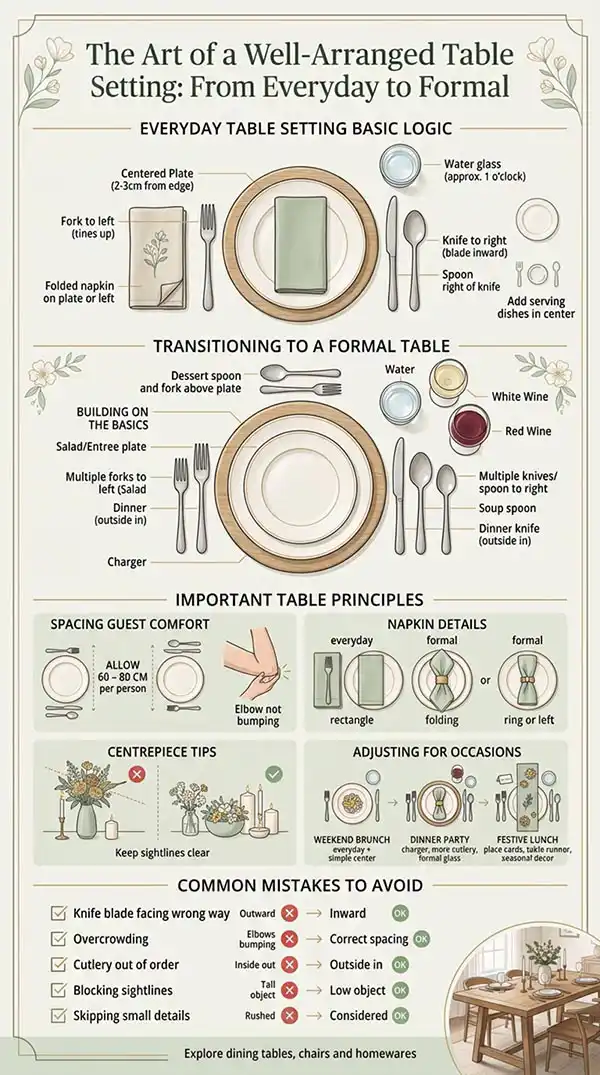
Start with the plate, centred directly in front of each chair, roughly two to three centimetres from the edge of the table. The fork sits to the left of the plate, tines facing up. The knife sits to the right, blade facing inward toward the plate, with the spoon placed just to the right of the knife. A water glass sits above the knife, roughly at the one o'clock position if you imagine the plate as the centre of a clock face.
A folded napkin can sit either to the left of the fork or directly on top of the plate. For an everyday table setting, that is really all you need. Add serving dishes to the centre of the table once the food is ready, and the table is properly set without any fuss.
2. Setting a Formal Table:
A formal table setting builds on the same basic logic as that outlined above, simply with more pieces added in a specific order. This is worth knowing for special occasions, dinner parties, or festive meals where you want the table to feel a little more elevated.
For a formal setting, start with a charger, a larger decorative plate that sits underneath the dinner plate and stays on the table between courses. The dinner plate sits on top of the charger, with a salad or entree plate placed above it, if a starter course is being served.
Cutlery is arranged in the order it will be used, working from the outside in, toward the plate, a convention followed by formal dining etiquette more broadly. If you are serving a salad course before the main, the salad fork sits to the outside left of the dinner fork. If soup comes first, the soup spoon sits to the outside right of the dinner knife. A dessert spoon and fork are placed horizontally above the plate, spoon facing left and fork facing right, ready to be pulled down when dessert is served.
Glassware follows a similar outside-in logic. The water glass sits closest to the diner, with the wine glass or glasses positioned slightly to the right and behind it. If both a white and red wine are being served, the white wine glass typically sits closer to the water glass, with the red wine glass positioned slightly further along.
3. Table Placement and Spacing:
Before any cutlery goes down, it is worth thinking about how much space each guest actually has at the table. As a general guide, allow around 60 to 80 centimetres of table length per place setting. This gives each person enough room to sit comfortably, use their cutlery without bumping elbows, and get in and out of their seat easily.
This spacing guide becomes especially useful when planning for a larger group. Measuring the full length of your table and dividing it by the recommended spacing tells you how many people can genuinely sit comfortably, rather than relying on how many chairs happen to fit around it. Squeezing in one extra place setting might look fine on paper, but it usually means elbows knocking throughout the meal.
Placemats are a simple way to define each person's space clearly, and they also protect the tabletop from heat and spills. For a more formal table setting, a full tablecloth creates a cohesive base for the rest of the setting to sit on top of.
4. Napkins: Folding and Placement:
Napkins are a small detail that make a noticeable difference to how considered a table feels. For an everyday setting, a simply folded napkin placed under the fork or laid across the centre of the plate is all you need.
For a more formal occasion, napkins can be folded into a rectangle or triangle and placed on top of the plate or threaded through a napkin ring positioned either on the plate, or to the left of the forks. Cloth napkins generally read as more 'special occasion' than paper do, and coordinating them with your tablecloths or a single accent colour, helps tie the whole setting together.
5. Choosing Tablecloths and Tableware:
The tablecloth and tableware you choose have a big impact on how a table setting feels overall, even before a single piece of cutlery goes down. A tablecloth suits a table you want fully covered, or one where you are after a calm, unified look, while a table runner is a lighter option that still adds texture and colour while letting the character of the timber or stone tabletop remain visible.
It is also worth thinking about the material your tableware is made from, since this can affect how you handle and store it as much as how it looks on the table. Stoneware and ceramic dinnerware are durable and dishwasher friendly, making them a practical choice for everyday settings, while fine bone China suits special occasion tables but generally needs a little more care when washing and stacking. Glassware follows a similar logic, everyday tumblers can go straight in the dishwasher, while delicate stemware is best washed by hand to avoid chips or breakage over time.
6. Adding a Centrepiece:
Once the place settings are done, a simple centrepiece finishes the table without competing with the food or the settings themselves. A low arrangement of flowers or greenery, a cluster of candles, or a simple bowl works well and keeps sightlines clear for conversation.
Candles are one of the easiest ways to add warmth to a table setting, particularly for an evening meal. If you prefer not to use an open flame around a table full of food and guests, a battery-operated candle gives a similar flickering glow without the concern of an open flame.
Whatever centrepiece you choose, keep an eye on height and width relative to your guests. Anything tall enough to block eye contact across the table, or wide enough to force elbows inward, tends to get pushed aside partway through the meal regardless of how good it looks when the table is first set. A centrepiece that survives the whole meal in place is generally a better sign of success than one that simply photographs well before anyone sits down.
7. Adjusting Your Setting for Different Occasions:
Not every meal calls for the same level of table setting and knowing how to scale your table placement up or down for the occasion makes the whole process much less daunting.
For a casual weeknight dinner, the basic everyday setting covered earlier is genuinely all you need. For a relaxed weekend brunch with friends, adding a simple centrepiece and coordinated napkins lifts the table without much extra effort. For a proper dinner party, layering in a charger, a few extra pieces of cutlery for additional courses, and a slightly more considered centrepiece signals that the occasion is a little more special.
For festive meals such as Christmas lunch, many hosts go a step further again, adding place cards, a table runner, and seasonal touches such as pine, citrus, or dried florals through the centrepiece. The core setting logic stays exactly the same throughout; it is simply a matter of adding or removing layers to suit the occasion.
8. Common Table Setting Mistakes:
- Knife blade facing the wrong way. The blade should always face inward toward the plate, not outward toward the next setting.
- Overcrowding the table. Skipping the spacing guide and squeezing in extra guests makes the whole table feel cramped rather than considered.
- Forgetting to work outside in. Placing cutlery in the wrong order can genuinely confuse guests about which piece to use for which course.
- A centrepiece that blocks sightlines. A tall, wide arrangement placed directly in the centre of the table makes conversation awkward and often gets moved anyway.
- Skipping the small details. Napkins, placemats and glassware placement are easy to rush, but they are exactly the details that make a table setting feel properly finished rather than thrown together.
- Rushing the setup right before guests arrive. A table set with five minutes to spare rarely looks as considered as one set at a relaxed pace earlier in the day, since small details tend to get skipped under time pressure.
|
Ready to Put Your Own Dining Table Setting Together? Explore our range of dining tables, dining chairs and homewares online, or visit us at our Alexandria showroom to see the pieces in person. We would love to help you put it all together. |
Frequently Asked Questions About Table Settings
Q: What is a good table setting for everyday use? |
| A: Centre the plate in front of each chair, place the fork to the left and the knife and spoon to the right with the knife blade facing the plate, and add a water glass above the knife. A folded napkin and a simple centrepiece finish the look without needing any extra pieces. |
Q: How do you set a table setting step by step? |
| A: Start with the plate centred in front of the chair, add the fork to the left and the knife and spoon to the right with the blade facing the plate, then place a water glass above the knife. Finish with a folded napkin and, if you like, a simple centrepiece in the middle of the table. |
Q: Which side does the fork go on in a table setting? |
| A: The fork always sits to the left of the plate, with the tines facing up. The knife and spoon sit to the right, with the knife blade facing inward toward the plate rather than facing outward. |
Q: How much space should I allow per person in a table setting? |
| A: Allow around 60 to 80 centimetres of table length per person. This gives each guest enough room to use their cutlery comfortably and get in and out of their seat without crowding the table. |
Q: Do I need a charger plate for a formal table setting? |
| A: A charger is not essential, but it is a common feature of formal table settings. It sits underneath the dinner plate, stays on the table between courses, and adds a layer of visual polish for a more special occasion. |
Q: What is the correct order for glassware in a table setting? |
| A: Glasses are placed above the knife, arranged largest to smallest from back to front. The water glass sits closest to the diner, with wine glasses positioned slightly to the right and behind it, generally following a diagonal line down toward the plate. |